
Where Is the Iberian Peninsula? |Location, Countries, & Significance
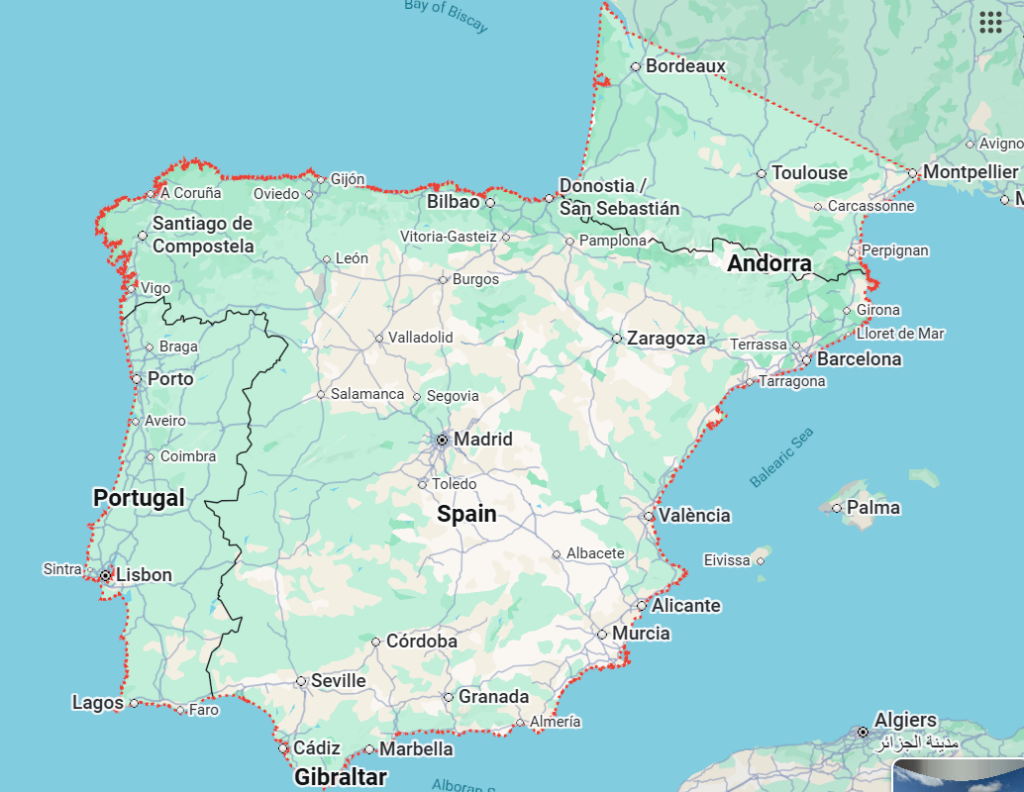
From time to time, when we give hints and answers for daily Worldle country games, the first clue we usually share is the region where the country is located on the world map. One of the regions you might come across, depending on the country, is the Iberian Peninsula. But where exactly is the Iberian Peninsula? Where is it located, and which countries should come to mind when you see this hint? Find out below.
Location
The Iberian Peninsula is located in the southwestern corner of Europe and is one of the continent’s most geographically distinct regions. It is almost entirely surrounded by water, with the Atlantic Ocean to the west and northwest and the Mediterranean Sea to the east and southeast. To the northeast, it is connected to mainland Europe through the Pyrenees Mountains, which form a natural border with France and Andorra. This strategic position gives the peninsula access to both major maritime routes while also providing a natural mountainous barrier from the rest of Europe.
This unique combination of oceanic coastlines and mountain boundaries has made the Iberian Peninsula an important crossroads between Europe and the Atlantic world. Its geography has strongly influenced its climate, cultural development, and historical role, helping shape it into one of Europe’s most significant and influential regions over thousands of years.
Countries
The Iberian Peninsula is mainly shared by two large countries, along with a couple of smaller territories. Each has its own political identity, but they all sit within the same geographic landmass.
| Country / Territory | Notes |
|---|---|
| Spain | Occupies most of the peninsula |
| Portugal | Located on the western Atlantic side |
| Andorra | Small microstate in the Pyrenees |
| Gibraltar (UK territory) | British Overseas Territory at the southern tip |
Spain is the dominant country in terms of size and population, while Portugal forms the western coastal strip. Andorra is a tiny independent state located high in the mountains, and Gibraltar is a small but strategically important territory at the entrance to the Mediterranean Sea.
NOTE
Under the traditional geographic definition, the Pyrenees Mountains form the northeastern boundary of the Iberian Peninsula. Because of this natural border, a very small portion of southern Metropolitan France (a narrow strip just beyond the Pyrenean watershed) can technically fall within the peninsula’s geographic limits.
However, in most modern and practical usage, the Iberian Peninsula is understood to include Spain, Portugal, Andorra, and Gibraltar, while France is generally not considered part of it. The mention of French territory is mainly a matter of strict geographic interpretation rather than common regional classification.
Capital Cities
Each country on the Iberian Peninsula has a capital city that serves as its political and administrative center. These capitals are also major cultural and economic hubs in the region.
| Country / Territory | Capital City |
|---|---|
| Spain | Madrid |
| Portugal | Lisbon |
| Andorra | Andorra la Vella |
| Gibraltar (UK territory) | Gibraltar |
Madrid and Lisbon are especially significant as two of Southern Europe’s most important capitals, both playing major roles in finance, culture, and tourism.
Significance
The Iberian Peninsula holds deep historical, cultural, and global importance. It was a major part of the Roman Empire, and later experienced centuries of Moorish influence, which left lasting marks on its architecture, language, and science. Following the Reconquista, Spain and Portugal became powerful kingdoms that led the Age of Exploration, sending explorers across the world and shaping global trade and colonization.
Today, the peninsula remains culturally rich and diverse, with widely spoken languages such as Spanish and Portuguese, along with regional languages like Catalan and Basque. It is also known for its varied landscapes, from coastal beaches to mountain ranges and inland plateaus. Economically and politically, Spain and Portugal are key members of the European Union, while the entire region remains one of Europe’s most visited and culturally influential areas.